Introduction
Waste management in Vietnam has always been challenging and urgent for all stakeholders involved. The waste management systems and processes still have many inadequacies and shortcomings, leading to improper waste treatment, environmental pollution, and adverse effects on people's lives.
The project focuses on designing app features to help residents classify municipal household waste in 10 days.
Process
Strategy and Scope
At first, I didn’t have much knowledge about the topic, so the features required weren’t specific and clear. With the time constraint of 10 days, I decided to design for short iterations (3 to 4 days each), the solutions would be improved after each iteration.
The project conducted secondary research, gathering information and analysis from previous studies and reports. These sources are used to inform the subsequent design decisions.
Research
According to statistics, Hanoi generates 7,000 tons of household waste per day. Most of them are transported to landfills and processed through burial methods, while some are incinerated manually, and only a small portion is sent to plants with proper treatment. As a result, the accumulation of waste at landfills is increasing, causing environmental pollution, impacting the lives of nearby residents, and consuming land resources.
A highly effective solution for waste management is to promote a circular economy, where the output waste of one industry becomes the input material for another. Currently, the main economic activity in Vietnam is linear economy. Experts suggest that to promote a circular economy, environmental protection infrastructure needs to be synchronized and ensure efficient operations at all stages.
Sorting waste helps synchronize and increase the efficiency of waste collection and transportation. Properly transported waste reaches the correct treatment plant, eliminating the need for factory workers to sort waste before it is processed by machine. Properly sorted waste enhances the processing capacity and volume of waste treatment. Therefore, increasing the quantity and quality of sorted waste contributes to the synchronization of technical infrastructure, promotes a circular economy, and helps create a better living environment.
So, I decided it would be helpful to create features that support residents in classifying waste.
In many streets, it’s common to see large and small garbage bags thrown in one place or another. Waste is often wrapped in plastic bags, placed in front of the house, waiting for collection. Many places where they’re carelessly discarded, and not properly sealed, causing litter to spill onto the street, leading to pollution and bad aesthetic appeal.
From people’s perspective, many residents are not well informed about the regulations, policies, and guidelines made by local authorities. They lack awareness of environmental protection, prefer convenience to save time and effort. When collecting, waste is not sorted, piled up, and mixed on garbage trucks making people feel that their efforts don’t have any impact at all.
What factors influence people's waste sorting behavior? Research findings indicate that waste sorting behavior is influenced by three factors: individual attitudes (such as economic benefits, environmental protection, etc.), social relationships (neighbors, friends, family, colleagues, etc.), and perceived behavioral control (available resources, obstacles, opportunities, etc.). Individuals with strong social relationships are more likely to engage in waste sorting. Both spiritual satisfaction and economic incentives are important factors driving people’s waste sorting behavior.
After getting the necessary information, I started to think of some possible features. To increase the quantity and quality of classified waste, I thought that information must be consistent, easy to understand, and accessible, even for individuals with limited social relationships. I assumed that there are two ways people approach information at different times. When the time is plenty, users will read in a top-down approach to gain a comprehensive understanding. But most of the time, they just want to know the specific waste sorting information they need.
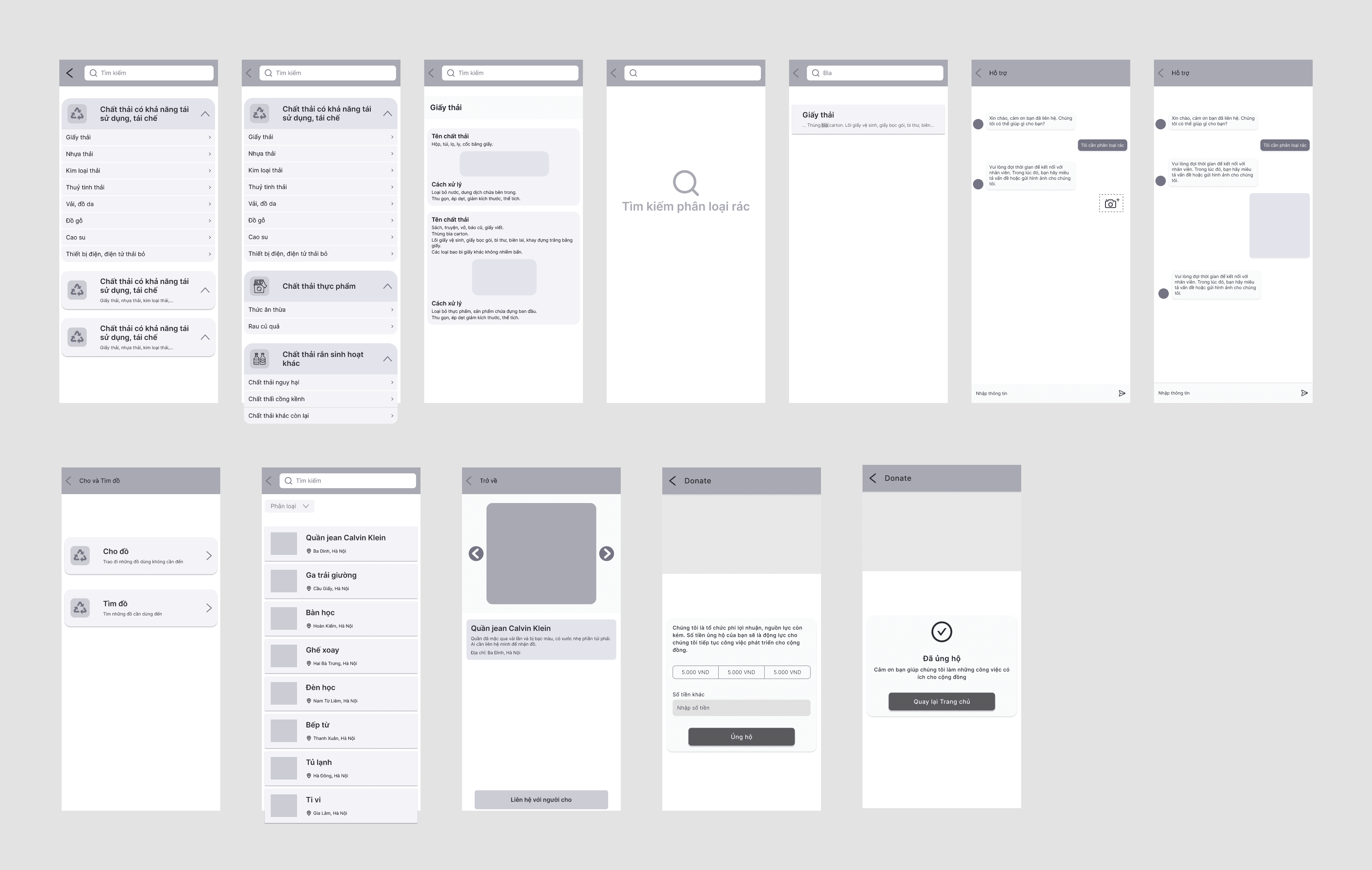
Based on that, I suggested 5 features. First, a feature to guide residents on waste classifying by providing text (short content), images, and videos to enhance information engagement. Second, a quick search tool for waste sorting content. Third, support for residents with other information: asking what type of waste something is, how to handle a particular type of waste, etc., with the help of a chatbot.
Fourth, to reduce the amount of waste disposed of in the environment, I created a feature to connect people with surplus items to those who need them, without any cost. These items could include clothes, tables, chairs, bookshelves, and more. The next feature will provide videos and images to connect and promote environmental activities.
I’m aware that working in the environmental industry is very challenging, people don’t get encouragement and credit enough. Therefore, the last feature would be donation, to help motivate those who are doing the job, emphasizing that they are doing a valuable and meaningful job in protecting everyone's living environment.
The process of waste sorting is complex, extensive, and the proposed solutions above, in my opinion, are not sufficient. The involvement of laws and policies is essential to enhance the effectiveness of waste sorting participation. This can be achieved by encouraging residents, improving infrastructure for better waste treatment, and building trust among people in the positive impact of their waste sorting behavior.
Sketches and Wireframe
The features should have simple layout and color scheme to ensure easy reading and information understanding. It should have a minimalist, user-friendly, and approachable style. Components are designed for vertical reading, ensuring a consistent reading experience across both small and large devices. I chose the McGreen app to implement these features. Due to time constraints, I couldn’t implement all the proposed features. I only focused on designing and implementing 5 key features: guidance, support, search, sharing, and donation. Here are the designs.
Designing and Presentation